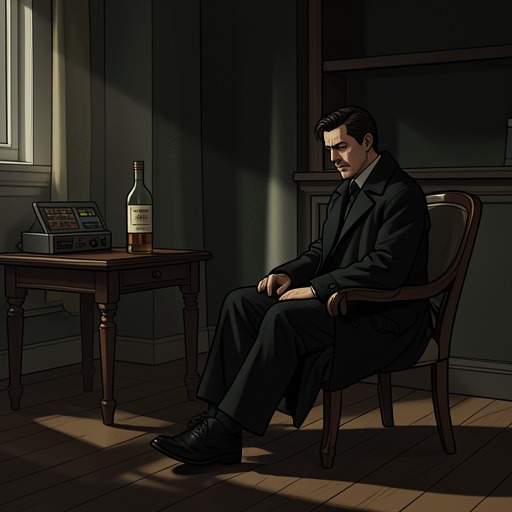
Patrick Casati's Alcoholism
And Their Children After ThemPatrick Casati’s alcoholism is not a single crisis but a succession of drinking lives: sociable excess, hidden workplace drinking, spells of abstinence, and repeated relapse, culminating in a level of consumption described as an effort to exhaust himself. It gradually narrows his days and relationships, even as familiar routines—work, gardening, fishing, and preparing for Anthony Casati’s visit—continue around it.
A History of Changing Drinking Patterns
Patrick’s drinking shifts with the circumstances of his life. In an earlier period, it belongs to parties and friendship: the nights leave him with patchy memories, and he deals with the morning after with aspirin and Coke. Later, he goes on binges lasting several days, followed by self-pity and repentance. In those spells he lectures his friends and considers returning to the church, making remorse part of the cycle without breaking it.
Another phase brings alcohol into his working life. Patrick hides bottles in the locker room and chews gum to conceal his breath; coworkers cover for his repeated mistakes. The same drinking life holds both convivial and domestic scenes: laughter at the bistro gives way to gloomy returns home, shouting matches, and sleeping on the living-room sofa, with Anthony witnessing the conflict. After Metalor shuts down, drinking becomes therapeutic in his own practical sense: a way to relax, encourage himself, and forget his problems while unemployed.
Abstinence does occur, sometimes lasting long enough that he stops drinking even on weekends. But the account presents these periods less as resolution than as waiting for relapse. A small drink can become the beginning of a much larger return to drinking. When he is not drinking, he avoids going out and seeing people; Christmas and the daily approach of evening become difficult occasions, as he fears both his friends and the familiar hour when the urge arrives. The temptation presents itself as a harmless pleasure, but the next day finds him badly undone and starting over.
Daily Life and the Recession of Work
In his later routine, Patrick lives on welfare in a studio apartment and holds a modest job with a private building manager: twelve hours a week at minimum wage. He cleans at quiet residences, takes out garbage, and mows the lawn when the weather permits. The work also brings occasional requests from older residents for small repairs and carpentry, for which they tip him. At first he feels humiliated when someone from his former life sees him mopping a floor; gradually he accepts the job as one as good as any other. Debts remain large beside his small income, and he receives a housing subsidy.
The town lets him cultivate a patch behind the Renardière soccer stadium. He plants potatoes, onions, parsley, and strawberries, but the visits repeatedly turn into drinking sessions. After three cans of beer, he sets down his spade, sits in a camp chair, smokes cheap tobacco, and looks at the disturbed earth. As the sun sets behind the bleachers, he may remain there among empty cans, slumped and occasionally laughing to himself. He says he feels good in these moments, but the practical consequence is plain: the potato harvest is poor, and he mostly eats canned food anyway. Fishing continues too, set beside a life the narration describes as diminished and anesthetized.
His studio gives this contraction a physical setting. The supposed ground-floor apartment lies five steps down and takes light through basement windows; one nine-by-twelve-foot room serves as living room, kitchen, and bedroom, with the toilet in the shower. Patrick builds shelves to make better use of the space, and his twin bed doubles as a sofa. He prepares canned ravioli on a camping stove, eats before the television, and drinks wine with lunch. On a day when Anthony is expected, he has a glass, then another, then a third before falling asleep again. The small domestic tasks continue, but the day’s timetable bends around drinking and sleep.
Relapse, Isolation, and the Body
The account distinguishes Patrick’s current drinking from the earlier patterns that preceded it. Those earlier eras had returned in confusing succession; now he drinks like someone pursuing a personal record, pushing toward a limit that will leave him drained. During the drinking, he experiences a sense of command and power. The same account marks the danger in that feeling: others can see that he is capable of anything, and his thirst is figured as having no endpoint short of death. This is not simply another episode of convivial excess or a response to unemployment, but an escalation in both intensity and threat.
The quieter scenes show the cost after the drinking has become ordinary. Patrick spends gloomy evenings with Picon-bière in front of the television, falls asleep with his mouth open, and wakes suddenly at three in the morning with a cold ache across his lower back. He struggles to rise for work, then returns home too tired to do anything else. He promises himself one glass, loses his resolve, and empties cans one after another. That homebound repetition occupies most of his life. He has fallen out with almost everybody, does not want to go out or see anyone, and feels empty and exhausted.
His hands make the loss especially tangible. Patrick looks at their brown spots and remembers their strength and appearance; he wants to put them to work, to grip a handle and use tools. He has learned practical skills—woodcutting, tiling, repairs, and basic carpentry—and is still capable of using them in small jobs. Yet he experiences his unused capacity as a source of agitation: fever and anxiety rise, and he feels himself becoming dangerous. The contrast is between a body trained for useful labor and a life increasingly spent sitting, drinking, and repeating the same evenings.
Care, Fatherhood, and the Limits of Change
Alcohol does not erase Patrick’s attention to Anthony, but it complicates how that attention is expressed. Before a fishing outing, Patrick buys fresh bait and returns with weevil grubs in an old Nesquik tin whose pierced lid he remembers from Anthony’s childhood. The tin recalls the boy as a small child holding a bowl of hot chocolate in both hands. Patrick recognizes that he did not take Anthony fishing often and sees the outing as something to do before his son leaves. The memory and the practical preparation disclose affection, while also emphasizing the time and closeness that were missed.
On another visit day, Patrick makes the apartment immaculate for Anthony. He washes the dishes, gathers five full bags of empty bottles, and drives them to the recycling bin; afterward he opens the windows and lies smoking on the bed, with the television low. The cleaning is a deliberate act of preparation, not evidence that his drinking has ended. He has already been drinking, and the broader account describes a life in which promises of moderation repeatedly give way. What changes for this occasion is the care he takes to make room for his son.
Patrick feels proud that Anthony is coming to see him and thinks of his son’s impending military service in Germany through the reassuring ideas of order, discipline, and steadiness. That anticipation stands beside, rather than resolves, Patrick’s own instability. His history includes attempts to stop, renewed drinking, lost work capacity, family conflict, and isolation; the narrative offers no lasting recovery as an outcome. Instead, alcoholism appears as a cycle that can coexist with tenderness and practical competence while steadily narrowing the life in which those qualities can be used.